Comet Tale Productions is a Boston-based video production house. We hope that through this blog you will learn more about the behind-the-scenes of corporate video.

www.comettaleproductions.com


Showing posts with label production. Show all posts

Friday, September 20, 2013

Film Breakdown Friday: Werckmeister Harmonies

Introduction

Yesterday, I wrote about how turning your video project into a film project is a mindset. In order for your video to move into the category of film, you have to invest the majority of your effort in pre-production and story. The film is made long before the first day of shooting.

Today is the first post in what will be a weekly series of film breakdowns. I’ll pick a clip from a movie, or corporate video and break it down into a couple bite sized chunks that you can consume and incorporate into your next project.

If you haven’t had a chance to see many foreign films, brace yourselves for this coming clip. Most commercial American movies have an incredibly fast paced editing rhythm. The following scene from Béla Tarr’s Werckmeister Harmonies occurs over the course of one long take. In order to pull up the English subtitles, you have to manually activate them by selecting the CC button in the lower right hand corner of the player and then selecting English subs.

Take a look at the scene:


The Breakdown

Béla Tarr is an extremely intentional director. His famously long shots are planned well in advance and he is able to see the movie in his head before it ever hits the silver emulsion of 35mm black and white film (and yes, despite films decline in popularity, Tarr continues to shoot on it). And that is what separates the directors of great films from the masses—the ability to take a strong personal vision and bring it to life on film.

The reason I picked this scene as the first film breakdown Friday is to show an incredibly intricate scene so that I can talk about storyboarding. Sure, anyone could set up a camera and have it run for eight and a half minutes but what makes Tarr’s scene from Werckmeister so powerful is the interaction between the camera and the scene itself. The camera is not a passive observer. It is an active participant in this scene subtly attuning the audience to the emotional tone of the moment.

I want to break down the scene into smaller chunks to show how the camera works to tell the story. There is a short bit of the beginning that this Youtube link is missing that gives a sense of the space before Valuska’s entrance. But as Valuska enters the bar, his movement opens up the frame from a tight shot of him and one of the drunks to a very wide shot of the entire empty bar. He now has a stage on which to perform his opening philosophical and astronomical monologue.

The next shift occurs as he corrals the barflies into position as the sun, earth and moon. The camera like our attention moves in to focus on Valuska and his model solar system. The proximity of the camera to our speaker gives us a sense of connection and safety as he twirls these drunken men around in circles. But the revelation of an eclipse results in yet another shift.

To the ancients, an eclipse was a terrifying event—day turning to night. With no scientific explanation for them, they determined that it was a bad portent. At first the camera moves in to a close up to reveal Valuska’s thoughts as he expounds upon the darkness of the eclipse, but as he proclaims the complete silence that arrives, the musical score enters and the camera begins to pull back. This move is the most powerful of the scene as the meditative silence of Valuska, the haunting beauty of the solo piano and the wide, high-angle shot all work in harmony to convey a sense of loneliness that the darkness brings.

But the eclipse cannot last forever. As the moon moves away and once again reveals the bright warmth of the sun, the camera too returns to its position of safe proximity. As it settles, all the men of the bar take up the waltz and for the first time in the scene, Valuska leaves the frame granting full autonomy to his drunken solar system.

In the closing moments, the bartender urges everyone to go home and the floor clears resulting in an almost cavernous emptiness. Valuska walks through the void and as he leaves, tells the bartender that “it’s still not over.”

Takeaways

Two of the key takeaways from this scene are (a) in order to execute a complicated choreographed scene, you have to plan everything in advance and (b) use the camera’s positioning and framing to enhance the meaning of your shot.

(a) The amount of planning that must have gone into filming this scene was immense. I’m willing to bet that the actors all rehearsed their movements many times. The cinematographer and gaffer watched those rehearsals like hawks and developed their lighting plot accordingly. But before anyone even set foot in that bar, Béla Tarr mapped that scene out in his head and put the major moments down on paper in storyboard form.

When planning to shoot your corporate film, make sure to take the time to think out every shot and how it will all interact together in the final product.

(b) The camera can be a powerful ally. The framing and composition of your shots will have a large impact of how the audience reacts to the image. Close up shots bring the audience close to your subject and allow them to see minute emotions. Wider shots give more of a sense of the setting. The size of the subject compared to the setting can convey a number of different things. The small figure of Valuska in the bar during the eclipse gives a profound sense of loneliness whereas the more crowded and closer view of the spinning barflies is safer and more comforting. Pay attention as well to the angle of the camera. A straight on eye-level shot is most common but if you move the camera along the vertical axis, you can elicit different responses. A low-angle shot where the camera looks up on an individual typically connotes power and the opposite high-angle shot connotes weakness.

As with any “rule” in film, everything is dependent upon specific circumstances at hand. But the way to ensure you are striking a chord with the audience is to know why you are implementing any technique. So long as you have a well-thought out reason for your actions, the audience will realize there is meaning even if they can’t specifically pinpoint what it is.

Thursday, July 25, 2013

The Method behind the Magic -- Production

If you’ve decided to hire out the production process, you can kick back and relax while your professional film crew works its magic, though it never hurt anyone to learn a little bit more. So even if you hired out, you might find this post interesting. If you’re going the DIY route, this will provide insight into some of the factors that go into making the shot itself look pretty good. This entry will be on the abstract side of things without a ton of reference to hyper-specific film tools (a post on equipment is in the future).

When you go to see The Avengers or Transformers 5, you’re actually looking at images that have been thoroughly thought out and meticulously lit (a lot of hard work goes into those types of movies; a shame it isn’t directed elsewhere). One philosophy of filmmaking is to draw as little attention as possible to the technical aspects of production and design shots to look as natural as possible. This, however, does not mean that the crew just plopped a camera on the ground and hoped for the best. Composition, lighting, camera movement, and acting performance are all aspects of production that I will delve into. There are other factors such as art department, hair & makeup, and wardrobe that I am not as familiar with so I won’t make myself look like an idiot by trying to talk about them, but do know they exist.

Production

            Composition – one of the first things that comes into place when setting up a specific shot is the composition of the image within the frame. You’ll often here “rule of thirds” get tossed around with regards to composition. As with anything in art, the rules are guidelines and should not be applied “just because they’re the rules.” Some things to consider when setting the composition of the shot: (a) where is your subject in the frame? (b) what is your eye level? (c) what direction is your subject looking (d) is the background interesting without being distracting? (e) is there anything in the foreground to add depth to the shot?


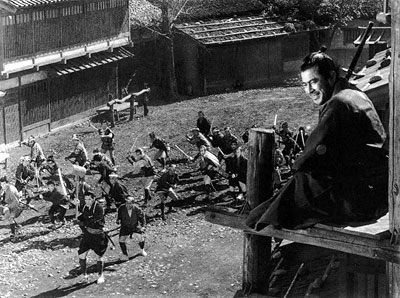
Let’s break down this image from Akira Kurosawa’s film Yojimbo (upon which Sergio Leone based his spaghetti Western A Fistful of Dollars). If you’ve seen the movie, you know that Toshiro Mifune has pitted two small-town gangs against one another and now sits atop a watchtower laughing as the two groups of thugs have a classic stand-off in the center of town. Kurosawa is a master of composition, managing to convey so much information in even a still frame. Mifune’s elevation atop the tower positions him in a role of power. As the tiny figures of thugs in the background dance around, Mifune can relax and laugh. Kurosawa places Mifune at the far right of frame and he only fills about one quarter of the whole image leaving the rest of the frame to encompass the blundering bandits. The shot has both foreground and background action capturing two stories at once.
            You can learn about composition from any number of art forms. Photography and painting are two great mediums you can visit to learn from the masters as well.

            Lighting – once you know the composition of the shot you want to get, you can light it to draw attention to the most important aspects within the frame. Light, or lack thereof, helps the viewer’s eye focus. Before telling you about any methods of lighting, you should know that different light has different color and these differences become a lot more noticeable on video if you don’t set your camera correctly. Color temperature refers to the color of light and it is usually measured in degrees Kelvin (which is a measure of heat, the color temperature has something to do with the color that a black body entity emits when it is heated to that temperature. I’m not a physicist, I just do movies). The two major benchmarks that are important to know are: standard daylight is 5600 degrees Kelvin and tungsten filaments are 3200 degrees Kelvin. If you have fluorescent tubes or compact fluorescent lights in your office, they probably run a gamut of color temperatures and most likely have a green spike to them as well.
A good place to start if you’re just starting to dabble in the art of lighting is the classic “three point lighting” technique where you have your key light (the main source of illumination), the fill light (which reduces any unwanted shadows) and back light (which helps separate the subject from the background). I’m not going to break down a lighting set up for you this post, but there’s a great article at No FilmSchool that reverse engineers a shot from Ridley Scott’s Blade Runner.


Camera movement – if you want to incorporate steady camera moves into your video (not Blair Witch-style shaky handheld) it’s probably going to add a little more to your budget. There are some lower tech options that have their limitations but can be worth the price and some higher tech options that require a larger crew but can create some pretty impressive shots. Rather than deal with the specifics of the equipment, I want to stress the importance of intent behind camera movement. As an artistic purist, I am not a fan of throwing camera moves into a shot list “because they look cool.” The most powerful films are those in which all the elements work to create a unified and cohesive goal. This means that every decision is intentional and has some basis in the story. Shane Hurlbut, ASC has a fantastic post about the intent behind the camera move in a film he shot, Mr. 3000.

Acting performance – whether you’re using your company’s code monkeys or somehow managed to land Ryan Gosling, you’re going to want to get the most out of their acting ability. Directing, like everything else in the film world, is hardly an exact science. No two actors work the same way, so what works for your Python performer is probably not going to work for Gosling. Some general advice, however, is in order. Make sure your talent is as physically comfortable as possible. Do they have water? Do they have a comfortable place to wait while the shot is being composed? I personally don’t like to let the actor watch takes of him/herself before their picture wrap. I don’t want them seeing some little tick that only they can see and altering their entire performance as a result. Some people nail the shot on the first try, others need a couple warm ups. Try to get a feel for the rhythm of your actor. Finally, let them own the performance. Line readings (where you tell the actor exactly how to say the line) often do more harm than good as they are now just parroting you and not delivering a sincere take. It is also advisable not to call attention to a specific word. If someone stutters during an interview, tell them your cameraperson screwed up and ask them to start over.

I know I said that this post would be combined with the editing guide, but I got carried away again. So tune in tomorrow to read about some of the things that go into the editing process. Do you have any production stories? Any shoots that went terribly right or terribly wrong (the horror stories are always the most interesting)?

-- by Joseph Baron

Sunday, July 7, 2013

A Nose for Film


It’s pretty well accepted that if you want to be a successful filmmaker, you’ve got to have a nose for business. But how important is it to have a nose for film as a business-person? In this inaugural post on the Comet Tale Productions blog, I’ll talk for a bit about the importance of video from a business perspective.

Today’s society, the most visually oriented society to date, consumes an incredible amount of images. We are absolutely inundated with visual stimulus from billboards, to print advertisements, to instagram, to television and YouTube. Netflix members watch more than 1 billion hours of television shows and movies through the service per month. Instagram users post more than 45 million photographs per day (that’s a whopping 1,350,000,000 photos in a 30-day month). The importance and prevalence of visual media today is quite clear, and it can be used for far more than merely posting a picture of your breakfast with a nostalgic filter.

While it’s not necessary that every business-person have a keen understanding of video (sorry accountants), marketers should definitely take some time to familiarize themselves with the power and uses of video. Time for a rapid-fire statistics break: 
  • videos can increase business calls by 18%, the number of business profile clicks by 30%, and website visits by 55%
  • the average social video campaign generates a 30% ROI just by being shared and passed around
  • video in e-mail marketing increases click-through rates by over 96% 

What is it about video that makes it such an effective tool? For this, I’m going to give my own personal, “soft” answer to this. I haven’t performed controlled experiments to deduce these findings; they’re merely my own personal musings on the power of video. Aside from an in-person encounter, video is the most human form of communication—text sits passively on the page, radio broadcasts disembodies voices, still images freeze life artificially in time. Viewers connect on a deep level with video (I’m sure mirror neurons have a thing or to do with that as well). And it is this emotional connection, resonating within the psyche of the viewer, that makes video such a powerful tool.

Looking to increase your brand recognition, announce a new product, attract a new class of recruits? There’s no better way to do all that than with a succinct and heartfelt video.


Stay tuned for a post on the process behind the final product—a post on what goes into producing a video.

-- by Joseph Baron